Quick answer: Turnkey project management means one agency takes responsibility for running your house project from planning to handover: design coordination, approvals support, construction, material buying, site supervision, progress reporting and final snagging. For an NRI or an out-of-city owner, it replaces the need to coordinate many vendors from a distance. It works well when four things are in place: a detailed written scope and specification, a stage-wise payment schedule, a clear reporting routine (photos, videos, calls and site-visit access) and a trusted local representative or documented authority to take decisions on your behalf. Distance does not have to mean loss of control, but it does mean you must set up the control system before work begins.
Many Faridabad families have a son or daughter in another country, or an owner working in Bengaluru, Pune or Dubai, who wants to build or rebuild on a family plot. The challenge is not construction itself. It is trust, visibility and decision-making across time zones. This guide explains how a managed, single-agency approach works, what to put in writing and how to stay in control from far away.
What is turnkey project management?
Turnkey project management is the coordination and delivery of an entire construction project by a single agency against an agreed scope, schedule and specification. "Turnkey" refers to receiving a finished building and only needing to turn the key.
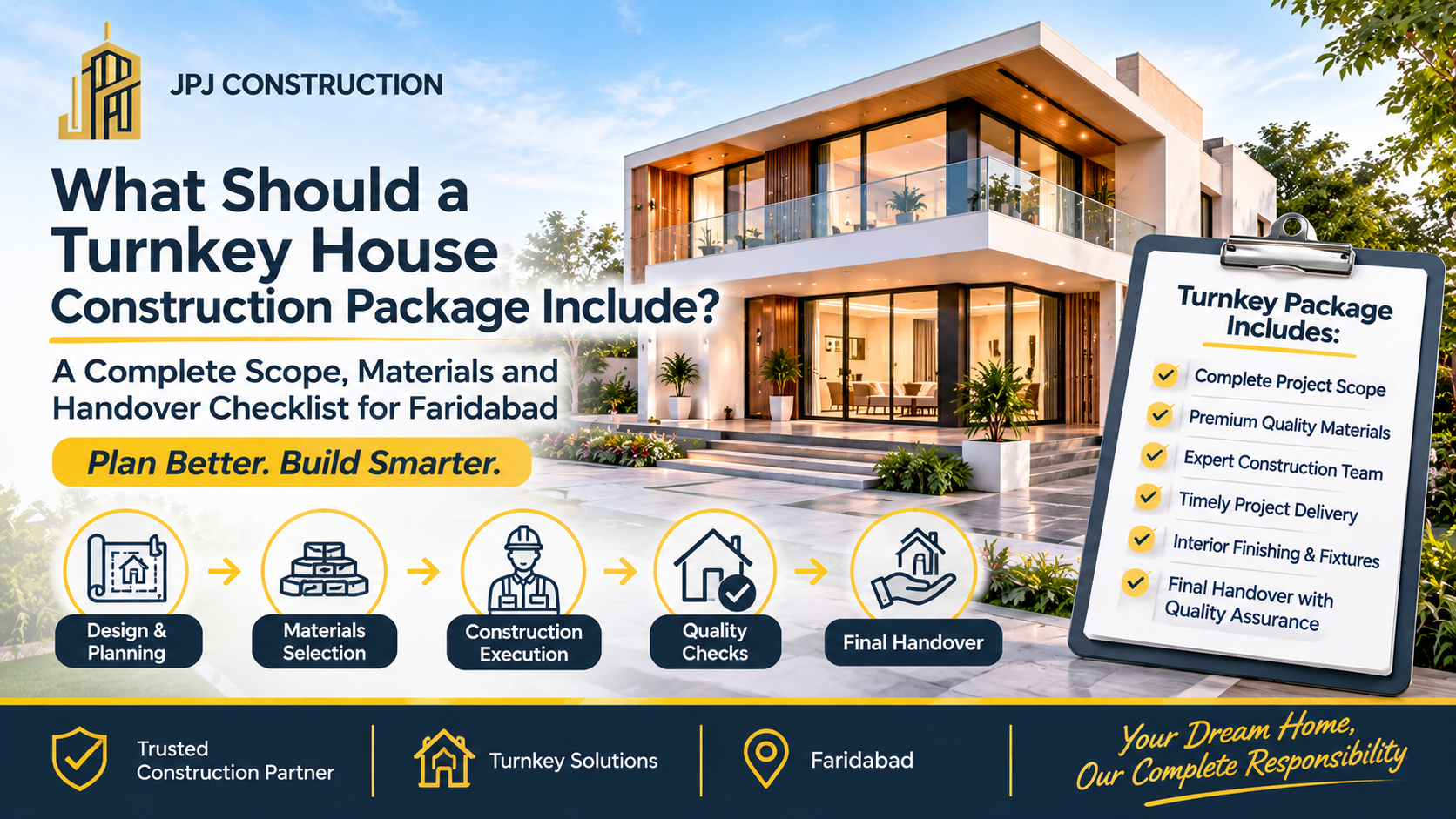
Depending on the agreement, a managed project may include:
- Coordination of architectural, structural and services drawings
- Support with approvals and documentation
- Construction of the structure and finishing work
- Procurement of materials
- Scheduling and supervision of trades
- Quality checks at key stages
- Progress reporting to the owner
- Snagging and handover
The exact scope is set by your contract, not by the label. Two agencies using the word "turnkey" can offer very different things, so always read the scope.
Why do NRIs and out-of-city owners choose a turnkey approach?
Building remotely creates specific problems that a managed project is meant to solve.

Turnkey is not the only option. Owners with a trusted relative on site, or construction experience, sometimes manage item-rate or labour contracts. The right choice depends on how much time and local support you have.
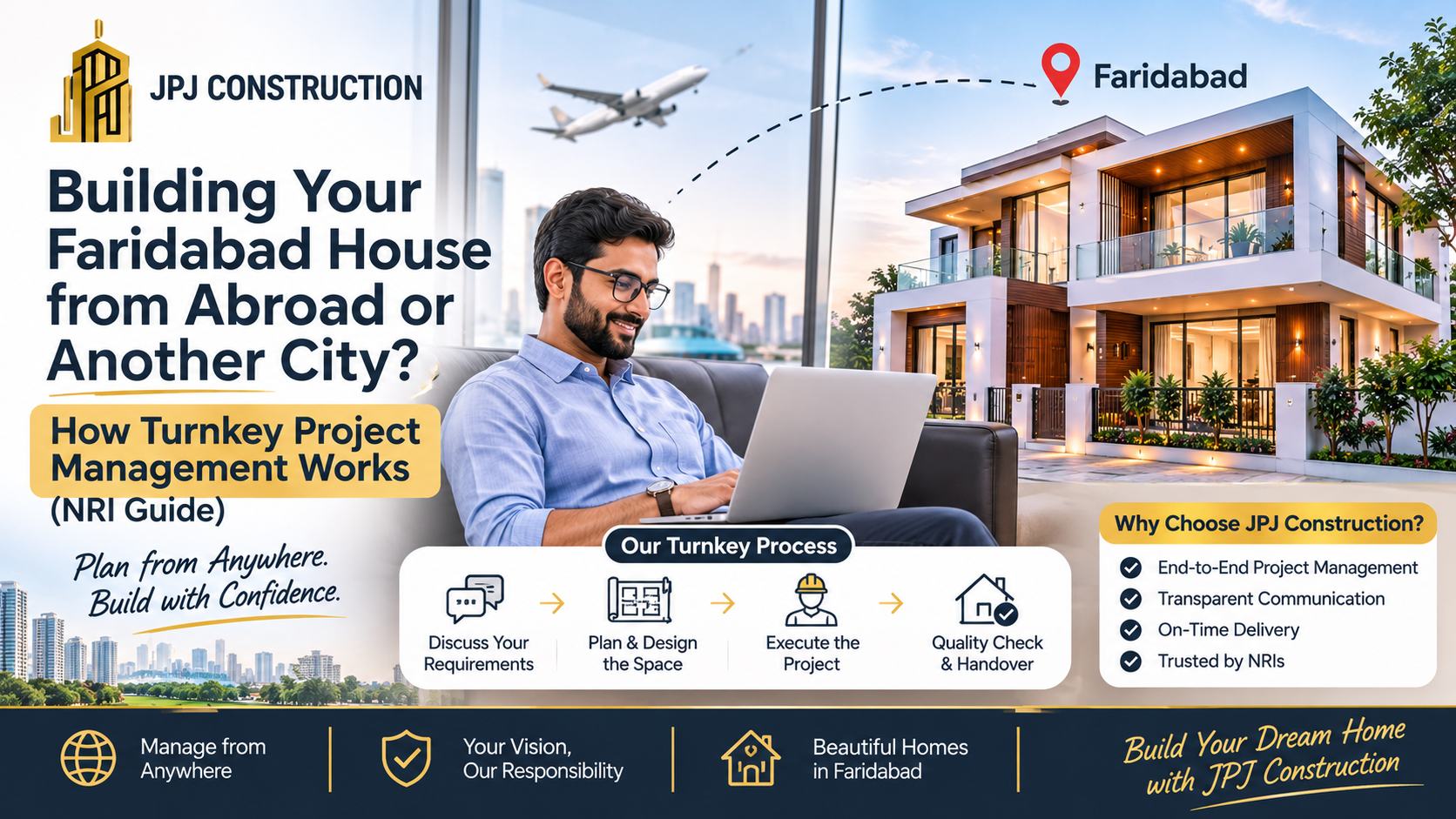
How does the process work from start to finish?
Here is a typical sequence. Phases and names vary by agency, so ask for your own version in writing.

What paperwork and legal points should NRIs check?
Rules about property and construction for non-resident Indians involve legal and financial regulations that can change. The points below are general guidance only. Confirm each with a lawyer, chartered accountant or the relevant authority before you act.
- Ownership documents: Keep clear title documents, the sale deed or inheritance papers, and tax receipts for the plot.
- Type of property: Rules differ for residential and agricultural or farmhouse land. Check what is permitted for your plot and status.
- Approvals: Building plan approval and permitted floors, coverage and setbacks depend on the authority for your plot, such as HSVP or the Municipal Corporation Faridabad, depending on location.
- Power of attorney (POA): If someone will sign or collect documents on your behalf, a properly drafted and registered POA may be needed. Have a lawyer draft it and limit it to what is necessary.
- Payments: Understand how funds will be transferred from abroad, how payments will be recorded and which taxes apply. A chartered accountant can advise.
- Utility connections: Electricity and water connections may need documentation and sometimes personal verification.
If an agency or a family member asks you to sign a broad authority without explanation, pause and take legal advice first.
How do you stay in control from far away?
Control comes from systems, not from constant calls. Set these up before you sign:
- A single point of contact: One named project manager or coordinator, and a named site supervisor.
- A reporting schedule: For example, weekly written updates with dated photos and short videos, and a monthly call. Agree the format and frequency in writing.
- A decision log: A shared record of every approval, change and instruction, with dates.
- Approval gates: Defined points where work pauses for your approval, such as design sign-off, before concreting each slab, before plastering and before finishing.
- A response-time agreement: How quickly you will respond to queries and how quickly the agency will respond to you.
- A local representative: A trusted relative, friend or independent engineer who can visit the site at key stages if you cannot. Their role and authority should be written down.
- Access to the site and documents: You should be able to see drawings, bills, material approvals and payment records on request.
- Time-zone planning: Pick a recurring call slot that works for both sides.
What should a turnkey agreement include for an out-of-city owner?
A written agreement should list:
- Scope of work with item-wise inclusions and exclusions
- Drawings, and who prepares and owns them
- Specification sheet with brands, grades and finishes
- Payment schedule tied to completed stages
- Timeline with milestones and the process for handling delays
- Reporting routine and who is responsible for it
- Site supervision: who, how often and with what qualifications
- Change process: how variations are requested, priced and approved in writing
- Approval responsibilities: what the agency handles and what you must provide
- Material approval process: how samples and brands are approved remotely
- Quality checks at key stages and how you can verify them
- Handover process: snag list, documents, keys and defect terms
- Dispute process: how issues are escalated and resolved
If you are comparing turnkey project contractors, give each of them the same drawings, requirements and specification sheet so the proposals can be compared like for like. Compare scope first, then specification, then payment terms and timelines, and price last.
How should payments work when you are not on site?
Payments are where distance creates the most risk, so be disciplined.
- Link every payment to a completed, verified stage, not just a date.
- Keep the advance limited and clearly defined in writing.
- Pay through traceable banking channels and keep receipts.
- Ask for an invoice or written acknowledgement for each payment.
- Match each stage payment with a progress report and photos.
- Hold back the final payment until the snag list is cleared and verified.
- Avoid paying large sums upfront or relying on verbal agreements.
If anything about the payment plan feels rushed or unclear, ask for it in writing before you transfer money.
What does a good progress report look like?
A useful weekly or fortnightly report includes:
- Dated photos and short videos of each area where work took place
- A list of work completed and work planned next
- Materials delivered or used, with brand and quantity where relevant
- Any issues, delays or decisions needed from you
- Pending approvals and the date by which they are needed
- A comparison against the agreed schedule
Reports should be factual and specific. Vague updates such as "work is going well" are a warning sign.
Which stages deserve extra attention remotely?
Some stages are hard to correct once covered, so ask for detailed evidence or an independent check:
- Foundation and excavation: Soil condition, levels, steel placement and shuttering before concreting
- Slabs and columns: Reinforcement details, cover blocks, concrete placement and curing
- Plumbing and electrical rough-in: Layout, pipe testing and conduit placement before walls are closed
- Waterproofing: Bathrooms, terrace and balconies, with tests where applicable
- Finishing: Tile levels, joinery quality, paint coats and fixture installation
If you cannot be there, an independent engineer or trusted representative can verify these stages against the drawings and specification.
What about interiors and finishing from a distance?
Finishing involves many small selections, such as tiles, fittings, paint colours and lighting. These are hard to judge from photographs alone. Some owners ask for turnkey interior solutions as part of the package, where one agency also manages interior and finishing work. Whether this is included depends entirely on the agreement, so ask what the interior scope is, what is excluded and how selections are shown and approved remotely. A sample board, physical samples sent to a family member or a showroom visit by a representative can help you decide with more confidence.
Is it different for Faridabad, Delhi, Gurgaon and Noida?
The remote-management approach is the same across Delhi NCR, but approvals, plot rules and local conditions differ by city and authority. If your plot is in Faridabad, ask about the rules for your sector or locality. If you own property in Delhi, Gurgaon or Noida, ask the same questions about local experience instead of assuming that what works in one city applies to another. Be especially careful with approvals and documentation, since these are the areas where remote owners most often depend on others.
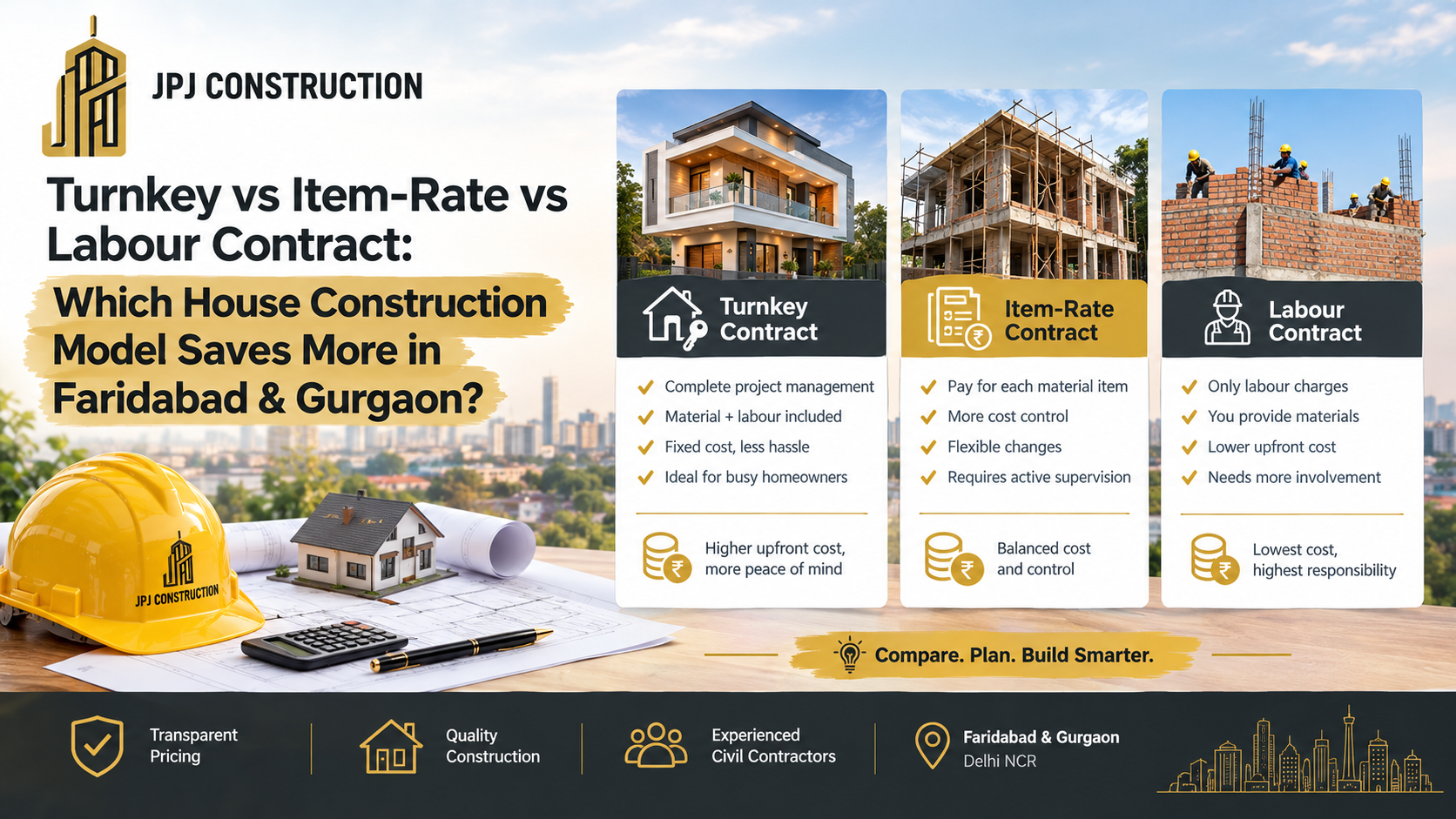
How do you compare a turnkey construction company with other options?

No model is automatically safest. The agreement and the people behind it matter more than the label.
What are the red flags for a remote project?
- Reluctance to put the scope, specification or payment terms in writing
- Pressure to transfer a large advance quickly
- No named supervisor or project manager
- Vague answers on how updates will be shared
- No access to bills, drawings or approvals
- Insistence on a broad power of attorney without explanation
- A quote far below others with no detail on what is excluded
- Refusal to allow an independent engineer or your representative to inspect
- Unrealistic promises on timelines
One concern alone does not make an agency unreliable, but several together are a reason to look elsewhere.
What should you do at handover if you cannot be there?
- Ask for a structured video walkthrough of every room, bathroom, terrace and exterior.
- Send a representative or independent engineer to inspect against a checklist.
- Have them test switches, sockets, taps, drains, doors, windows and locks.
- Review the snag list and agree on dates for fixes.
- Collect drawings, bills, warranty details and utility documents.
- Release the final payment only after verified completion.
- Keep all records in one shared folder.
How JPJ Construction approaches turnkey projects
JPJ Construction is a construction company serving Faridabad and Delhi NCR, providing construction, turnkey projects, civil work, architectural planning and design, and remodeling and renovation. If you are planning a house in Faridabad from abroad or from another city, you can read about our turnkey project services and share your plot details, requirements and how you would like to receive updates. Ask for a written scope, reporting routine and payment schedule that you can compare with any other proposal.
Next step: Before you contact any agency, gather your ownership documents, plot size, number of floors, essential rooms, timeline and a list of who can represent you on site. With that in hand, any agency can give you a clearer and more comparable proposal.
FAQs
How does turnkey project management work for NRIs?
One agency manages design coordination, construction, supervision, reporting and handover under a written agreement. You stay informed through agreed updates and approve key decisions remotely.
Can I build a house in Faridabad while living abroad?
Many NRIs do. You need clear ownership documents, approvals, a reliable agency, a reporting system and sometimes a local representative. Confirm legal and financial points, such as permitted property types and remittance rules, with a lawyer or chartered accountant.
Do I need a power of attorney to build remotely?
Not always. It depends on who needs to sign or collect documents on your behalf. If you use one, have a lawyer draft it, keep it limited to what is necessary and understand its scope.
How do I monitor construction from another country?
Agree on regular written updates with dated photos and videos, scheduled calls, approval gates at key stages and the option for a representative or independent engineer to inspect.
How should I pay a contractor when I am abroad?
Link payments to verified stages, use traceable banking channels, keep receipts and avoid large advances. Get tax and remittance advice from a chartered accountant.
What should be in a turnkey agreement?
Scope, drawings, specifications, payment schedule, timeline, reporting routine, supervision, change process, handover and defect terms, all in writing.
What does turnkey project management include?
Typically scheduling, coordination of trades, material procurement, quality checks and progress reporting. The exact services depend on the agreement, so confirm them in writing.
Is turnkey better than hiring separate vendors for remote owners?
It often reduces coordination effort and gives one accountable party, but only if the scope and reporting are clear. Separate vendors need much more local supervision.
Does a turnkey package include interiors?
Not always. Some agreements cover structure and basic finishing, while others include interior work. Check the scope, and ask how selections are approved remotely.
Who should inspect the house if I cannot visit?
A trusted relative, an independent engineer or a representative with a written checklist. Their role should be agreed in writing.
How do I compare turnkey project contractors?
Give each the same drawings and specification sheet. Compare scope and exclusions first, then reporting, payment terms and timeline, and finally price.
Does JPJ Construction provide turnkey projects in Faridabad?
JPJ Construction provides turnkey project services in Faridabad and Delhi NCR, along with civil work, architectural planning and design, and remodeling and renovation. Share your requirements and how you would like to receive updates to discuss what your project needs.