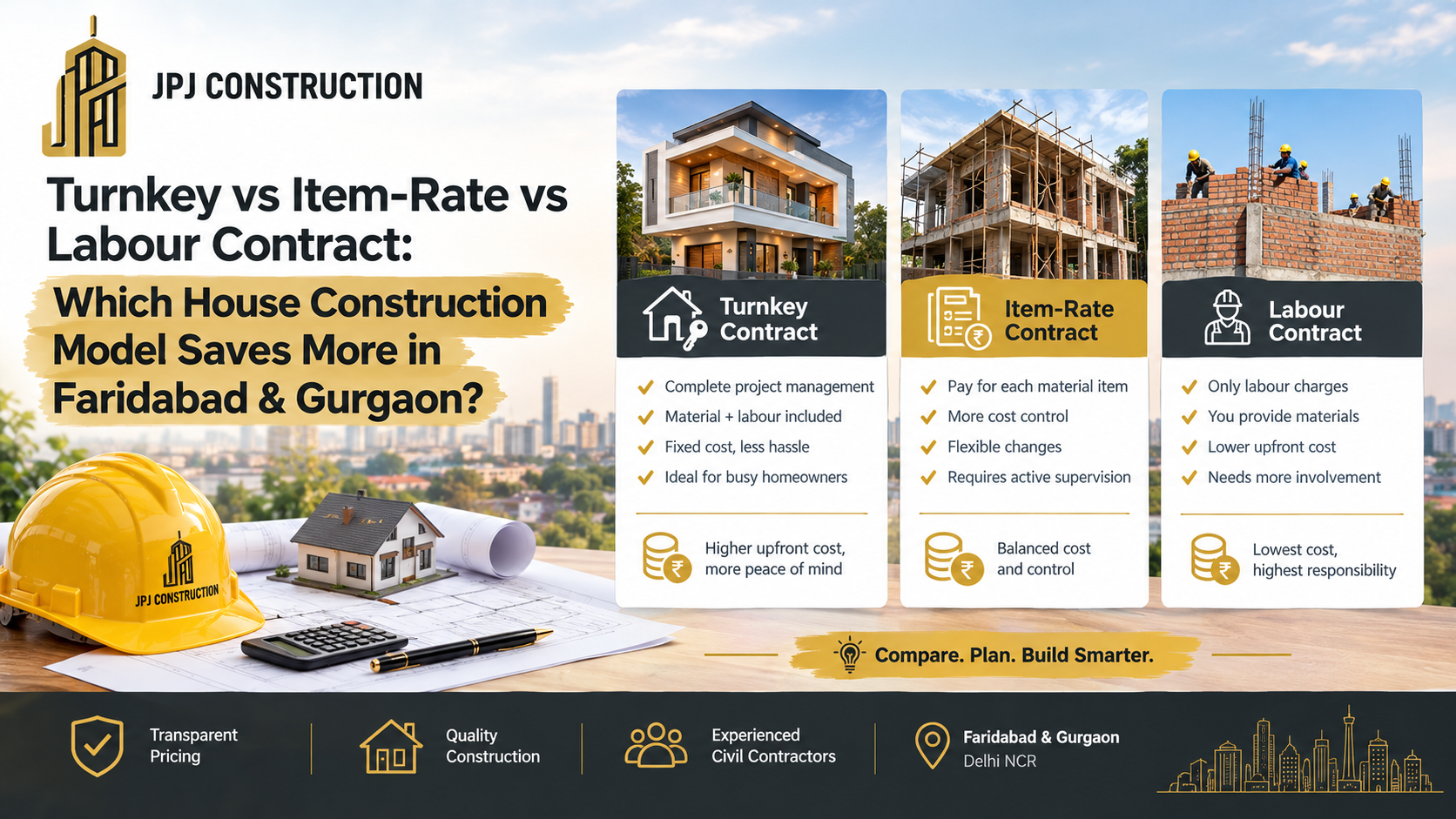
Quick answer: No single model is cheapest for every house. A labour-only contract usually has the lowest upfront rate, but you carry the risk of material buying, wastage and supervision. An item-rate contract gives you more cost visibility, because each work item is priced separately. A turnkey contract is often the most predictable, since one agency delivers the finished house, and it tends to save more when you value fixed scope, a single point of responsibility and less personal involvement. The model that saves you the most is the one that matches your time, experience and ability to manage the site. If you want one party accountable from planning to handover, a turnkey construction company is usually the simplest route.
Choosing the contract model is one of the earliest decisions in a house project, and it shapes your budget, your stress and your final quality more than most homeowners expect. This guide explains each model in plain terms, where the real savings and hidden costs come from, and how to decide for a house in Faridabad, Gurgaon or elsewhere in Delhi NCR.
What are the three main house construction contract models?

Names and practices vary between contractors, so always confirm exactly what your agreement covers.
What is a labour contract, and when does it make sense?
In a labour contract (often called a labour-only or "mistri" contract), you buy cement, steel, bricks, sand and other materials yourself, and the contractor provides workers and workmanship.
Where it can save money:
- You control material brands and purchase prices.
- You avoid the contractor's margin on materials.
- It can suit owners who already know suppliers and can negotiate well.
Where it can cost more than expected:
- Material wastage, theft and over-ordering become your loss.
- Delays in material arrival slow the labour, and idle labour can still demand payment.
- Quality control is yours. Mistakes in steel placement or concrete mix may not be noticed until later.
- There is usually no single party responsible for the overall outcome.
Best suited to: Owners with construction knowledge, time to visit the site daily, or a trusted engineer or supervisor.
What is an item-rate contract?
In an item-rate (or "BOQ-based") contract, the work is broken into items, such as excavation, PCC, RCC, brickwork, plastering and flooring, with a rate for each. You pay for work actually measured at the site.
Where it can save money:
- Costs are transparent, because you can see how the total is built up.
- You pay for work as measured, so you can compare contractors item by item.
- Changes can be priced at the agreed rates.
Where it can cost more than expected:
- The final bill can differ from the first estimate, since quantities are measured on completion.
- If the item descriptions are vague, disputes about measurement and specification can arise.
- Items missing from the list, such as waterproofing or site cleaning, may appear later as extras.
Best suited to: Owners who want transparency and are willing to review measurements and stage bills carefully.
What is a turnkey contract?
A turnkey project means one agency takes responsibility for delivering the house, typically from planning through construction and finishing, to a handover stage where the owner can start using it. The word comes from the idea of handing over the key to a finished building. The exact scope, for example whether it includes design, approvals, interiors or furniture, depends on the agreement.
Where it can save money:
- A defined scope and schedule reduce the risk of overruns and rework.
- One agency coordinates the trades, so there are fewer gaps and overlaps.
- Less time off work and fewer site visits for you.
- Material buying and wastage control are handled by the agency.
Where it can cost more than expected:
- The quote may be higher at first glance than a labour-only rate, because it covers more.
- If the specification is vague, you may get materials below your expectations.
- Changes after signing can be priced at a premium.
- Anything not listed in the scope is an extra.
Best suited to: Owners who live in another city or work full time, first-time builders, or anyone who prefers a single accountable party. Good turnkey project management also covers scheduling, quality checks and stage-wise reporting, so ask how the agency does this.
Which model saves more: a side-by-side comparison

The honest answer to "which saves more" is that a lower rate does not always mean a lower final cost. Savings come from avoiding rework, waste, delays and disputes. A model can look cheap on paper and become expensive in practice if nobody is managing the project well.
Where do the hidden costs come from?
Whatever model you choose, these are the places budgets usually slip:
- Rework: Fixing errors in steel, shuttering, levels or plumbing after concrete is cast.
- Delays: Time lost waiting for materials, labour or decisions, which can mean extra rent for you.
- Material wastage: Over-ordering, poor storage and losses on site.
- Unclear specifications: Disputes about what brand, grade or finish was promised.
- Scope gaps: Items nobody included, such as waterproofing, site clearance or utility connections.
- Mid-project changes: Design changes after work has progressed.
- Approvals and professional fees: Items often left out of the contractor's rate.
A turnkey or item-rate agreement with a detailed scope tackles most of these. A labour contract hands most of them to you.
Does the choice differ in Faridabad and Gurgaon?
The three models work the same way across Delhi NCR, but practical details differ by city. Plot regulations, approval authorities, local labour availability and the type of project, such as an independent floor versus a larger villa, vary between Faridabad, Gurgaon, Noida and Delhi. Gurgaon projects often involve more complex designs, and many owners there live away from the site, which tends to favour a managed arrangement. Faridabad owners building on family plots may be closer to the site and more comfortable with a hands-on approach.
These are general patterns, not rules. Check the applicable approval authority and building rules for your plot before finalising a design, and confirm what approvals your contractor will handle and what you must arrange yourself. A contractor familiar with the region can explain these differences before you sign.
How do you decide which model is right for you?
Ask yourself these five questions:
- How much time can I give the site? If the answer is very little, lean towards turnkey.
- Do I have construction knowledge or a trusted engineer? If yes, labour or item-rate becomes more practical.
- How firm is my design and specification? A finalised design suits any model; an undecided one causes problems in all of them.
- How much cost certainty do I need? If a fixed scope and schedule matter, turnkey or a well-defined item-rate contract helps.
- Who will be accountable if something goes wrong? In a labour contract, that is mostly you.
What should a turnkey agreement include?
Before signing with a turnkey construction company, check that the agreement states:
- Scope: What is included, from design and approvals to finishing, and what is excluded.
- Specification sheet: Brands, grades and finish levels for structure, flooring, fittings and paint.
- Drawings: Architectural and structural drawings, and who prepares them.
- Payment schedule: Tied to completed stages, not just dates.
- Timeline: Start date, milestones and handover period.
- Change process: How variations are approved and priced.
- Site management: Who supervises, how often progress is reported, and how you can inspect work.
- Handover: What documents, completion checks and snag-list process apply.
- Defect terms: What the agency offers after handover, in writing.
- Exclusions and extras: Furniture, modular kitchen, landscaping and utility connections, if not covered.
If you are comparing turnkey project contractors, give each of them the same drawings and specification sheet so that you compare like with like.
Does turnkey cover interiors too?
It depends on the agreement. Some turnkey packages stop at the structure and basic finishing, while others include turnkey interior solutions, such as modular work, woodwork and furnishing. Ask specifically what the interior scope is and what level of detail it includes. Do not assume it is covered unless it is written in the scope.
How can you reduce risk with any model?
- Finalise the design and specification before work starts.
- Get a written, itemised scope and keep copies of all agreements.
- Tie payments to verified progress.
- Visit the site at key stages, such as before concreting and before plastering, or ask an independent engineer to check.
- Keep a record of approved changes.
- Hold back a contingency for changes and price movement.
Which model should you choose? A quick guide

Working with a turnkey construction company in Faridabad and Delhi NCR
If you prefer one team to take your project from planning through construction and handover, a turnkey arrangement is worth discussing. JPJ Construction provides turnkey project services alongside civil work, architectural planning and design, and remodeling and renovation across Faridabad and Delhi NCR. You can read more about how this works on the turnkey project page, or share your plot details and requirements to talk through the scope that suits your house.
Next step: Before approaching any contractor, write down your plot size, number of floors, finishing preferences and timeline. Then ask for a quote that clearly states scope and specification, so you can compare models fairly.
FAQs
Which is cheaper: turnkey, item-rate or labour contract?
Labour contracts usually have the lowest upfront rate, but you carry material and supervision risk. Turnkey often costs more on paper but can reduce rework, delays and wastage. The cheapest option overall depends on how well the project is managed.
What is a turnkey project in house construction?
It is an arrangement where one agency delivers a complete project against an agreed scope, so the owner receives a finished house. The scope can include design, approvals, construction and finishing, depending on the agreement.
What is an item-rate contract in construction?
It is a contract where each work item has an agreed rate, and payment is based on measured quantities of work completed.
Is a labour contract risky?
It can be, because material buying, wastage control and quality supervision are your responsibility. It suits owners who have the time and knowledge to manage these.
Is turnkey construction worth it for a small house?
It can be, especially if you do not have time to supervise. The decision depends on how much responsibility you want to take on rather than the size of the house alone.
How do I compare turnkey quotes?
Give each agency the same drawings and specification sheet, then compare scope, exclusions, material grades, payment terms and timelines before comparing price.
What does turnkey project management include?
Typically scheduling, coordination of trades, material procurement, quality checks and progress reporting. The exact services depend on the agreement, so confirm them in writing.
Does a turnkey contract include interiors?
Not always. Some agreements cover structure and basic finishing only, while others include interior work. Check the scope.
Can I change the design during a turnkey project?
Usually yes, but changes are priced separately and can affect timelines. Agree on a change process before you sign.
Is the choice different in Gurgaon than in Faridabad?
The models are the same, but plot rules, approval authorities and project complexity can differ. Choose based on your project, your involvement and the contractor's experience in your area.
What should I ask before hiring a turnkey construction company?
Ask what is in and out of scope, how payments are staged, who supervises the site, how changes are handled, and what is offered after handover.
Does JPJ Construction offer turnkey projects?
JPJ Construction provides turnkey project services, civil work, architectural planning and design, and remodeling and renovation in Faridabad and Delhi NCR. Share your requirements to discuss what your project needs.