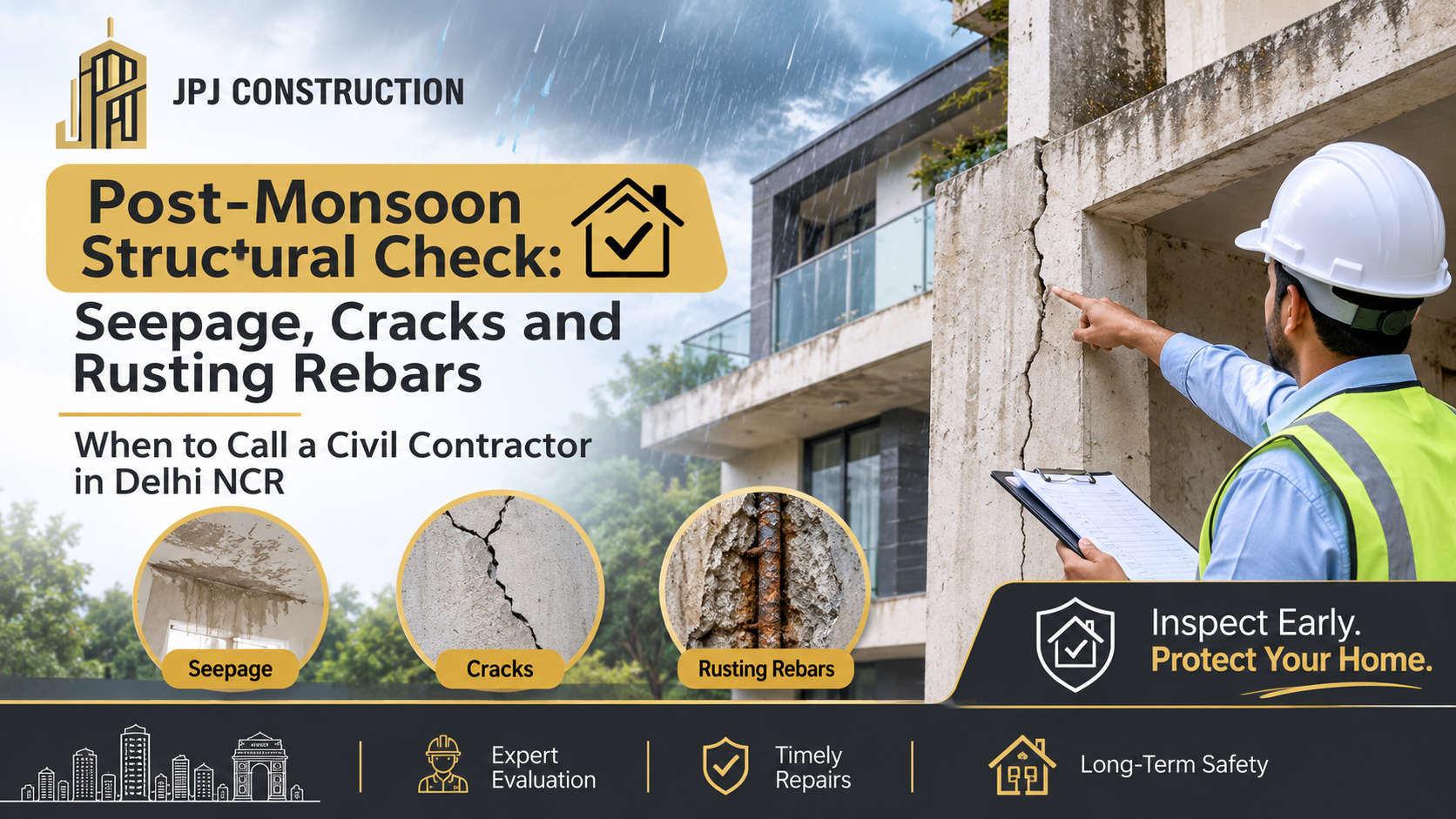
Quick answer: After the monsoon, call a civil contractor in Delhi NCR if you see seepage that keeps returning, cracks that are wide, growing or running through beams and columns, rust stains or flaking concrete that exposes steel, or a sagging slab. A thin hairline crack in plaster or a damp patch that dries within days is usually cosmetic. Anything that affects the structure, the steel or the safety of the building should be looked at by a qualified professional, ideally a structural engineer working with an experienced contractor.
The rains test every building. In Delhi NCR, water sits on terraces, seeps through walls, collects around foundations and finds every weak joint. The weeks after the monsoon are the best time to inspect, because the damage is visible and you can still repair it before it spreads. This guide shows you what to look for, what each sign usually means, and when a problem is serious enough to bring in a civil work contractor.
Why should you check your building right after the monsoon?
Water is the main cause of long-term deterioration in concrete and masonry. When it enters through a crack or a poorly sealed joint, it can reach the reinforcement steel inside the concrete, soften plaster, carry salts into walls and cause dampness. Left alone, small defects often become larger and costlier repairs.
Checking now has three advantages:
- Stains, leaks and cracks are fresh and easy to trace to their source.
- You can still repair before the next season, and before winter makes some repair work harder to cure properly.
- Early intervention is generally simpler than repairing damage after the steel has been corroding for years.
What are the three main post-monsoon warning signs?

Seepage: what causes it and when is it a problem?
Seepage is water moving through a building element that should be waterproof, such as a roof slab, wall or basement. You will see it as damp patches, peeling paint, efflorescence (white powdery salts), a musty smell or dripping.
Where does seepage commonly start?
- Terrace and roof slab: Failed waterproofing, poor slope, blocked drains or cracks in the screed.
- Bathrooms and sunken areas: Leaking joints, weak waterproofing below tiles, or plumbing defects.
- External walls: Hairline cracks, gaps around windows and window sills, and poor sealing at joints between the wall and the frame.
- Parapet walls and balconies: Water entering at the base or through cracked coping.
- Basements and boundary walls: Water pressure from the soil, poor drainage or no damp-proofing.
- Plumbing and drainage lines: Hidden leaks that look like monsoon damage but continue after the rain stops.
How do you tell if seepage is serious?
Seepage is more serious if it is:
- Still there weeks after the rains end
- Spreading to new areas or returning every season
- Accompanied by cracks, rust stains or a swollen or flaking surface
- Visible on ceilings under a terrace or bathroom
- Present in load-bearing elements such as beams and columns
A damp patch that clears within a few dry days usually points to a surface issue. Persistent dampness suggests the water path has not been fixed.
Cracks: which ones are harmless and which are not?
A crack is a visible separation in plaster, masonry or concrete. Not all cracks are structural. Many are caused by normal drying shrinkage or temperature changes, but some signal real stress.
How do you read a crack?

A simple way to monitor a crack
- Mark the ends of the crack with a pencil and note the date.
- Take a clear photo with a ruler or coin beside it for scale.
- Re-check after two to four weeks and again after the next heavy rain or temperature change.
- If it has grown, branched or widened, or doors and windows have started jamming, call a professional.
Do not simply fill a crack with putty and paint over it. That hides the evidence and does not fix the cause.
Rusting rebars: why is steel corrosion so serious?
Reinforcement bars (rebars) give concrete its tensile strength. Concrete normally protects the steel, but if water and air reach it through cracks, thin cover or porous concrete, the steel starts to rust. Rust takes up more volume than the original steel, so it pushes against the concrete from inside. That causes cracking and the concrete cover to flake off, which is called spalling. It exposes more steel and the cycle accelerates.
What are the warning signs of rebar corrosion?
- Brown or reddish stains running down a beam, column or slab underside
- Cracks that follow the line of the reinforcement
- Concrete chipping or falling off in pieces
- Exposed steel bars, especially if flaky or reduced in thickness
- Hollow sound when a surface is tapped
Corrosion can be hard to judge by eye alone. Whether it is a surface issue or a loss of steel section needs an engineer's assessment, so treat exposed or heavily rusted rebar as a reason to call someone, not a DIY job.
When should you call a civil contractor?
Call one promptly if you notice any of the following:
- Wide, growing or branching cracks, especially in beams, columns, slabs or load-bearing walls
- Cracks on both sides of a wall or running across multiple floors
- Spalling concrete or exposed, rusted rebar
- Persistent seepage that returns every season or has not dried weeks after the rain
- Sagging, bulging or deflecting slabs, beams or walls
- Doors and windows that suddenly jam or no longer close properly
- Dampness at the base of walls with salt deposits that keep returning
- Water entering a basement or foundation area
- Signs after any event such as a nearby excavation, an added floor, or a tremor
When is it an emergency?
If you notice a sagging ceiling, concrete falling from a slab or beam, a sudden large crack, or a bulging wall, move people away from the area and contact a structural engineer or qualified contractor immediately. Do not wait for it to dry out or rely on cosmetic fixes. If you are in an apartment building, also inform your RWA or society management, since structural elements are often shared.
Do you need a civil contractor, a structural engineer, or both?

For many homeowners, the practical route is a contractor who can inspect, tell you what needs an engineer's opinion, and then carry out the repair work. If you are looking for a civil work contractor to handle repairs and structural works, you can read more about JPJ Construction's civil work services for Faridabad and Delhi NCR.
What happens during a professional inspection?
A site visit typically includes:
- Discussion: Building age, previous repairs, where the leaks and cracks appear, and any changes made to the structure.
- Visual survey: Walls, ceilings, slabs, beams, columns, terrace, bathrooms, balconies and the foundation area where accessible.
- Moisture tracing: Finding where the water is entering, not just where it shows up.
- Crack assessment: Pattern, width, location and whether it is active.
- Steel condition check: Looking at any exposed rebar and spalled areas.
- Recommendation: Which items are cosmetic, which need repair and which need an engineer's input.
- Written scope: What will be done, with what materials and methods.
Ask for the findings and recommended work in writing. A clear scope helps you compare quotes properly.
How are seepage, cracks and corroded rebar usually repaired?
The method depends on the cause, so the steps below are general and not a substitute for a site assessment.
- Seepage: Trace and fix the source first, then waterproof the affected area. That could be terrace waterproofing, joint sealing, bathroom waterproofing or drainage correction.
- Non-structural cracks: Clean, seal and finish with a suitable repair material, and fix the cause if there is one.
- Structural cracks: Repair method is decided by an engineer after finding the cause. It may involve injection, stitching or strengthening.
- Rusted rebar: Remove loose concrete, clean the steel, treat or replace it as the assessment requires, then restore the cover with suitable repair mortar or concrete.
The sequence matters. Repairing the finish before fixing the source is the most common reason problems come back.
What can you check yourself before calling anyone?
Use this simple walkthrough once the rains have ended:
Terrace and roof
- Are drains clear and is there standing water after rain?
- Any cracks, loose or hollow-sounding tiles, or gaps at the parapet base?
Ceilings and walls
- Any stains, bubbling paint or white salt deposits?
- Cracks near corners of doors and windows?
Bathrooms and kitchens
- Dampness on the neighbouring wall or the ceiling below?
- Loose or cracked tiles and failing grout?
Structure
- Any rust stains, spalling or exposed steel on beams, columns or slab undersides?
- Any visible sag, bulge or tilt?
Outside the house
- Cracks in boundary walls or plinth?
- Water collecting near the foundation, or damp rising from the base?
Take dated photos as you go. They help the contractor understand what changed and when.
Why does this matter in Faridabad and across Delhi NCR?
Delhi NCR has a mix of older independent houses, builder floors, apartment buildings and newer construction, and the way you handle a problem depends on which one you live in. Older buildings may have ageing waterproofing and long-exposed steel. In builder floors and flats, a leak may come from a neighbour's unit or a shared element, so coordinate with the neighbours and the RWA. Terrace-heavy homes, basements and ground floors close to drains deserve extra attention after heavy rain.
Whether you need a civil contractor in Faridabad or help with a property in Delhi, Gurgaon or Noida, the inspection logic stays the same, though approval and society rules for repairs may differ by location. If your repair involves structural changes, check what permissions or society approvals apply first.
How do you choose a civil contractor for repair work?
- Ask for an inspection and a written scope before any commitment.
- Make sure they explain the cause of the problem, not just the repair.
- Ask what materials and methods they plan to use.
- Prefer stage-wise payment tied to completed work.
- Ask how they will handle anything that needs a structural engineer's opinion.
- Be cautious of anyone who offers a quick cosmetic fix for a structural problem.
JPJ Construction works across Faridabad and Delhi NCR on civil work, turnkey projects, architectural planning and design, and remodeling and renovation. For a repair or renovation after the monsoon, you can share photos and details through the civil construction services page to start the conversation.
What are the most common post-monsoon mistakes?
- Painting over damp walls before the cause is fixed
- Filling every crack with putty without understanding it
- Ignoring terrace drains and slope
- Treating rust stains as only a cosmetic problem
- Waiting until the next monsoon to act
- Hiring on price alone without a written scope
If you have noticed seepage, spreading cracks or rust on your concrete, record what you see with dated photos and ask a qualified professional to inspect before the next season. Contact us to discuss your property.
FAQs
What should I check in my house after the monsoon?
Check the terrace and drains, ceilings and walls for dampness, bathrooms for leaks, and beams, columns and slabs for cracks, rust stains or spalling concrete. Photograph anything unusual with a date.
Are cracks after monsoon dangerous?
Many are cosmetic, such as fine plaster cracks. Cracks that are wide, growing, run through beams, columns or slabs, or appear with rust stains need professional inspection.
How do I know if a crack is structural?
Structural cracks tend to be wide, follow a pattern such as diagonal or stepped, appear on both sides of a wall or in load-bearing members, and keep growing. A professional assessment is the reliable way to confirm.
What does rust on concrete mean?
Brown stains or flaking concrete usually mean the steel inside is corroding. This weakens the member over time and should be assessed by an engineer or experienced contractor.
Why does my wall still feel damp after the monsoon?
It may be residual moisture that will dry, or it may be an ongoing source such as a leaking pipe, a failed terrace or an external crack. If it persists for weeks, trace the source.
Can I just paint over seepage marks?
Painting hides the stain but does not stop the water. Fix the source and let the wall dry before repainting.
Who should I call for structural cracks, a contractor or an engineer?
For serious or unexplained cracks, involve a structural engineer. A civil contractor can then carry out the repair, and many homeowners find it easiest to have both coordinated.
When is the best time for waterproofing and repairs in Delhi NCR?
The dry period after the monsoon is generally suitable for inspection and many repairs, since surfaces have dried and the damage is visible. Your contractor can advise on timing for your specific work.
Is seepage in a flat my responsibility or the society's?
It depends on the source. Leaks from shared elements like the terrace or common walls are often a society matter, while leaks within your own unit may be yours. Check your society rules and coordinate with neighbours.
Does JPJ Construction handle post-monsoon repair and civil work?
JPJ Construction provides civil work and related construction services across Faridabad and Delhi NCR. Share your property details and photos on the civil work page to discuss what your project needs.