
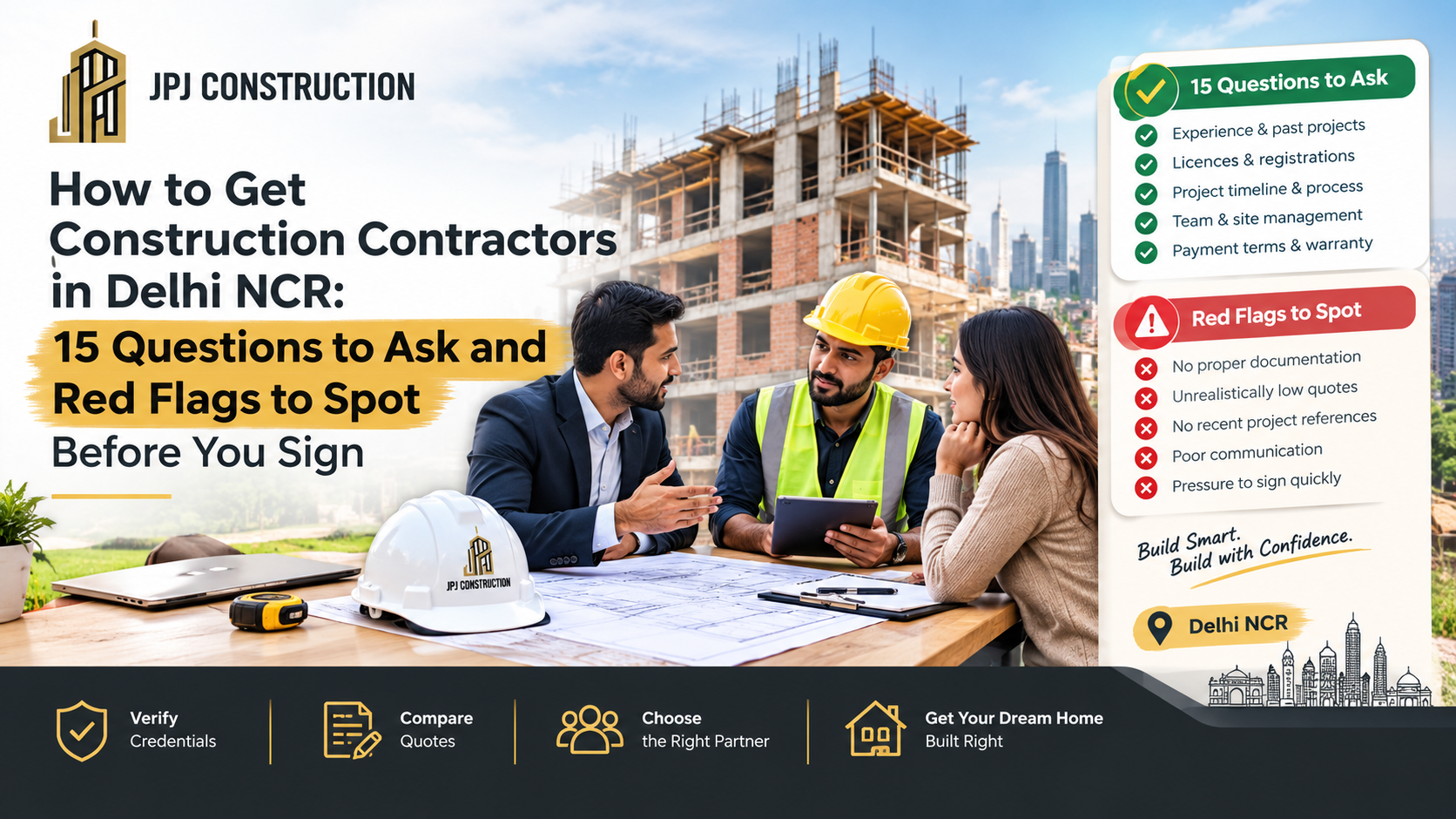
Quick answer: To vet construction contractors in Delhi NCR, check four things before you sign: their track record (visit completed or ongoing sites and speak to past clients), their paperwork (identity, registrations and a written contract), their clarity (a detailed scope, specification and payment schedule) and their process (who supervises the site, how changes are handled and what happens after handover). Walk away from anyone who avoids written terms, asks for a large advance, pushes you to decide quickly or cannot show real work. The 15 questions and the red-flag list below turn this into a checklist you can use with any contractor.
Hiring a contractor is the biggest decision in a building project. A good one turns your drawings into a sound, finished structure. A poor one can leave you with delays, disputes, rework and defects that surface years later. The market in Delhi NCR ranges from individual mistris and small contractors to organised firms, so the way you vet matters more than the name on the visiting card.
Why does contractor vetting matter so much?
Construction is hard to reverse. Once concrete is cast and walls are plastered, errors are expensive to fix. Most disputes come from the same causes: unclear scope, vague specifications, payments not linked to progress and nobody clearly responsible. Vetting before you sign is cheaper than fixing a problem later.
What types of contractors will you meet?

None of these is automatically better. The right choice depends on your project and how much you want to manage yourself. A reputable construction company in Delhi NCR should be able to explain exactly what role it plays in your project.
Where should you start your search?
- Ask people who have built recently, and ask to see the house, not just hear about it.
- Visit ongoing sites in your area.
- Check the contractor's website and social pages for real project photos and details.
- Shortlist three, not ten, and meet each in person.
- Give each of them the same drawings and requirements so the quotes are comparable.
The 15 questions to ask before you sign
Experience and track record
1. How long have you been doing construction work, and what kinds of projects?
Look for experience that matches your project, whether it is an independent house, a builder floor, a renovation or a commercial building. General experience is not the same as relevant experience.
2. Can I visit completed and ongoing sites?
A contractor confident in their work will usually arrange this. Look at finishing quality, site cleanliness, safety practices and how workers are managed. Ask the current owner, if possible, how the project has gone.
3. Can I speak to past clients?
Ask about delays, communication, cost changes and how problems were handled. Speaking to two or three past clients tells you more than any brochure.
Registrations and credentials
4. What business registrations do you hold?
Ask for the registrations that apply to their business structure, such as GST registration if applicable, along with a PAN and proper business identity. Rules vary by business type, so ask what applies to them and verify what they show you rather than assuming.
5. Do you have qualified engineers or architects involved?
Find out who prepares structural drawings, who checks the work on site and whether a licensed professional signs off where required. Do not accept vague answers such as "we have people for that".
6. Do you carry insurance or safety arrangements for workers?
Site accidents can create liability and delays. Ask how worker safety is handled and who is responsible if someone is injured on site.
Scope, drawings and specification
7. What exactly is included and excluded in your quote?
A good quote lists inclusions and exclusions in writing. Common gaps are waterproofing, approvals, utility connections, site clearing and electrical or plumbing fixtures.
8. Who prepares the drawings, and what do they cover?
Ask whether architectural and structural drawings are included, and who prepares them. If you need architectural drafting services or full planning and design, find out whether the contractor provides them in-house or relies on an outside professional, and who is accountable for the result.
9. What material grades and brands will you use?
Get steel, cement, brick or block, tile and fixture specifications written down. Without a specification sheet, a quote cannot be compared, and substitutions are hard to challenge later.
Money and contract
10. What is the payment schedule?
Payments should follow completed stages, such as foundation, slab, brickwork and plaster, rather than calendar dates. Ask how much advance is needed and what it covers.
11. How are changes and extras handled?
Agree on how variations are requested, priced and approved in writing before work starts. Unrecorded verbal changes are a common source of disputes.
12. Will everything be in a written contract?
The agreement should cover scope, specification, timeline, payment terms, change process and defect terms. If a contractor resists putting things in writing, treat that as a serious warning sign.
Process and accountability
13. Who will supervise my site, and how often?
Ask for the name of the site engineer or supervisor, how often they visit, and how you will receive progress updates. A project without clear supervision depends on luck.
14. How do you plan timelines and handle delays?
Ask for a milestone schedule and what happens if work runs late. Reasons for delay, such as weather or material supply, should be discussed upfront.
15. What happens after handover?
Ask for the process for snag lists, defect repairs and what support you get, in writing. A contractor who disappears after the final payment leaves you with the problem.
What are the red flags to spot before you sign?

One red flag does not always mean a bad contractor, but several together are a strong reason to look elsewhere.
What documents should you collect before signing?
- Written quote with itemised scope
- Specification sheet for materials and finishes
- Architectural and structural drawings, or confirmation of who prepares them
- Draft contract or agreement
- Payment schedule tied to stages
- Timeline with milestones
- Contractor's business details and any relevant registrations
- References or site-visit arrangements
- Change-request process
- Defect and handover terms
Keep copies of everything, including messages and approvals, in one folder.
How do you compare quotes from different contractors?
- Give every contractor the same drawings and requirement list.
- Ask them to quote in a similar format.
- Compare scope and exclusions first, then specification, then payment terms, and only then price.
- Ask each one to explain any difference that looks large.
- Check whether the lowest quote includes everything the others do.
A lower quote is only lower if it covers the same work, with the same materials and the same accountability.
Is it different for Faridabad, Gurgaon, Noida and Delhi?
The vetting process is the same across the region, but local factors differ. Approval authorities, plot rules, society or RWA requirements and labour markets vary between cities, and a contractor should understand the rules for your specific location. If you are looking for a construction company in Faridabad, ask about their experience in your sector or locality and who handles approvals. If your project is in Gurgaon, Noida or Delhi, ask the same questions about local experience instead of assuming it carries over. For apartment or society projects, check whether the society's permission is needed before work begins.
What is the difference between a civil construction company and a general contractor?
A civil construction company typically focuses on structural and core building work, such as foundations, RCC, masonry and related works. A general contractor may coordinate wider work, including finishing and trades. Some firms handle civil work, turnkey projects and renovation under one roof. Ask each contractor precisely which of these they do themselves and which they subcontract.
How should you evaluate a contractor during the first meeting?
Use a simple scorecard. Rate each item from 1 to 5.

Add up the scores for each contractor. The scorecard will not make the decision for you, but it helps you compare objectively and spot weak areas.
What should you do once you have picked a contractor?
- Finalise drawings and the specification sheet.
- Sign a written agreement that covers scope, payments, timeline and changes.
- Agree on stage-wise inspection points, such as before concreting and before plastering.
- Keep a record of approvals, changes and payments.
- Visit the site regularly, or hire an independent engineer to check key stages.
- Do not make the final payment until the snag list is cleared.
How JPJ Construction works with clients in Faridabad and Delhi NCR
JPJ Construction is a construction company serving Faridabad and Delhi NCR, providing construction, turnkey projects, civil work, architectural planning and design, and remodeling and renovation. If you are shortlisting contractors, you can use the questions above with us as well. Share your plot details and requirements, and ask for a written scope you can compare with other quotes.
Next step: Print the 15 questions, shortlist three contractors, and meet each with the same set of drawings and requirements. A short, structured comparison now saves a long, stressful project later.
FAQs
How do I choose a good construction contractor in Delhi NCR?
Check their track record by visiting sites and speaking to past clients, confirm their business registrations, get a detailed written scope and specification, tie payments to progress and make sure someone accountable supervises the site.
What questions should I ask a contractor before hiring?
Ask about relevant experience, completed and ongoing sites, references, registrations, who prepares drawings, what is included and excluded, material specifications, payment schedule, supervision, timelines, change handling and post-handover support.
What are the red flags of a bad contractor?
Refusing written terms, demanding a large advance, pressuring you to decide fast, being unable to show real work, giving vague specifications, having no named supervisor and quoting far below everyone else without explanation.
Should I pay an advance to a contractor?
Some advance is common, but the amount and its purpose should be written down, and the rest of the payments should follow completed stages. Be careful with large advances before work begins.
How many quotes should I get?
Two or three comparable quotes are usually enough. More than that can make comparison harder unless each quote follows the same drawings and specification.
Is the lowest quote the best option?
Not necessarily. A low quote may leave out scope, use cheaper materials or lead to extras later. Compare what is included before comparing the price.
Do I need a written contract for house construction?
Yes. A written contract that covers scope, specification, payment stages, timeline, changes and defect terms protects both you and the contractor.
Should I visit the contractor's previous sites?
Yes. Seeing completed or ongoing work and speaking to the owner is one of the most reliable ways to judge quality and behaviour.
What is the difference between a contractor and a turnkey company?
A contractor may handle only part of the work, such as labour or structure, while a turnkey company takes responsibility for delivering the complete project against an agreed scope.
Do contractors provide architectural drafting services?
Some do and some work with outside architects or designers. Ask who prepares the drawings, what they cover and who is responsible if there are errors.
How do I check a contractor's credentials in Delhi NCR?
Ask for business identity and any registrations that apply to them, verify what they show, check references, and confirm which qualified professionals are involved in design and supervision.
Does JPJ Construction work across Delhi NCR?
JPJ Construction serves clients in Faridabad and the wider Delhi NCR region. Share your project details to discuss what your location and requirements need.